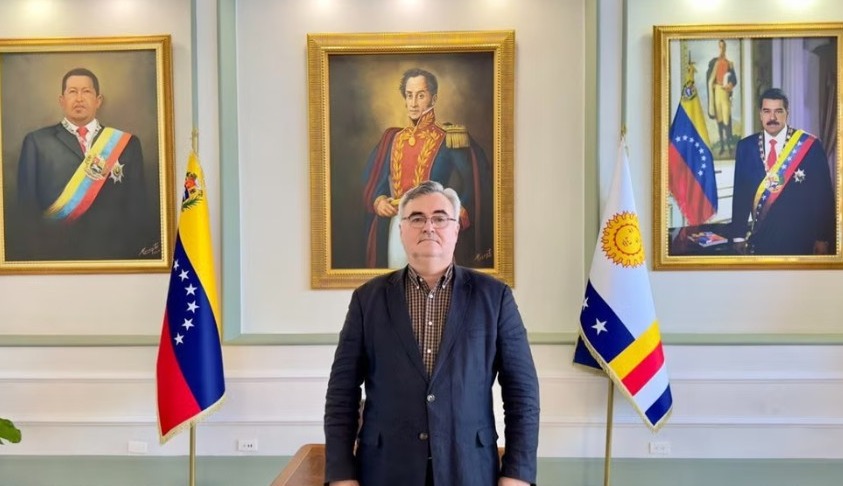
Russian and Venezuelan sources, as reported across both opposition and government-aligned media, agree that Russian Ambassador to Venezuela Sergey Melik-Bagdasarov gave an interview to the Russian channel Russia 24 in which he commented on the recent US-led operation that resulted in the capture of Nicolás Maduro and Cilia Flores. Both sides report that he linked the success of that operation to internal collaboration by Venezuelan actors with US intelligence, and to failures or negligence in Venezuela’s own security and defense structures, including the misuse of Russian-supplied air defense systems during the raid. There is also broad agreement that Venezuelan forces launched at least two Russian-made anti-aircraft missiles that failed to hit their targets, and that the ambassador publicly reaffirmed that Russia–Venezuela military cooperation remains in place and is expected to continue for decades despite the embarrassment caused by these operational shortcomings.
Coverage from both camps further converges on a shared contextual frame: the statements are presented against the backdrop of longstanding Russia–Venezuela military links, the deployment of Russian air defense systems on Venezuelan soil, and the broader strategic confrontation with the United States. Both opposition and government-aligned outlets note that US officials had previously questioned the effectiveness of Russian air defenses in Venezuela, and that Melik-Bagdasarov’s comments implicitly respond to those doubts while acknowledging some level of internal betrayal or complicity. They also agree that issues of training, institutional capacity, and loyalty within Venezuela’s armed forces and security agencies are central to understanding how the operation to capture Maduro unfolded, even as Russia publicly signals continuity in its strategic partnership with Caracas.
Points of Contention
Responsibility and blame. Opposition outlets emphasize the ambassador’s remarks as evidence that Venezuelan authorities themselves bear primary responsibility for Maduro’s capture, highlighting "negligence," "internal failures," and betrayal by officials as decisive causes. Government-aligned coverage, by contrast, frames his words as a narrowly focused reference to a few known traitors collaborating with US intelligence, insisting that he did not condemn Venezuelan institutions as a whole. While the opposition uses his comments to reinforce a narrative of systemic rot and incompetence, pro-government media selectively stress that the ambassador blamed external enemies exploiting isolated disloyal actors.
Military competence and Russian systems. Opposition reporting spotlights the failed launch of two Russian anti-aircraft missiles as proof that Venezuelan forces lacked adequate training to operate sophisticated Russian defense technology, implicitly questioning both the regime’s military professionalism and the real value of Russian support. Government-aligned sources downplay any suggestion of generalized ineptitude, focusing instead on the ambassador’s pushback against what he calls media “distortion” of his interview and avoiding detailed discussion of the misfires. For the opposition, the incident illustrates a hollowed-out military structure; for pro-government media, it is a limited episode being weaponized by adversarial outlets to smear both Venezuela and Russia.
Nature of the betrayal and its scope. Opposition narratives treat the ambassador’s reference to internal collaboration as confirmation of a deep, multi-layered betrayal within the Venezuelan state and security apparatus, suggesting that the regime is riddled with factions willing to cooperate with Washington. Government-aligned coverage narrows this down to a small group of Venezuelans who, according to the ambassador, have long been publicly known for “betraying their country,” insisting there is nothing new or systemic in what he said. Thus, opposition media extrapolate his comment into a broader indictment of the regime’s internal cohesion, while pro-government outlets insist it merely reaffirms well-known cases of individual treachery.
Media manipulation and credibility. Opposition outlets present Melik-Bagdasarov’s statements largely at face value, using them to corroborate earlier US assertions that Venezuela’s air defenses were ineffective and its security services compromised, and implying that Russian officials are inadvertently exposing the regime’s weaknesses. Government-aligned media, on the other hand, foreground the ambassador’s accusation that his remarks were taken out of context, portraying critical outlets as deliberately twisting his words to fabricate a crisis of confidence between Moscow and Caracas. Where opposition coverage uses the interview to validate its critical narrative about the state’s decay, pro-government reporting recasts the episode as an example of hostile media manipulation that must be rebutted to defend the legitimacy of both the Venezuelan government and its Russian ally.
In summary, Opposition coverage tends to treat the ambassador’s remarks as inadvertent confirmation of deep institutional failure, military incompetence, and pervasive internal betrayal at the heart of Maduro’s regime, while Government-aligned coverage tends to reframe the same comments as a limited warning about a few known traitors and a denunciation of hostile media distortion, all while underscoring the resilience of the Russia–Venezuela alliance.